
 Polski
The rustling of silk grosgrain, which under the fingers of a master tailor ceases to be just a haberdashery accessory and becomes the foundation of a construction worth a fortune. In the world of haute couture, where the work of the craftsman’s hands is at a premium, the ribbon has traveled a fascinating path: from Marie Antoinette’s courtly bows, to corsets protecting the female body, to avant-garde sculptures made of medical bandages. It is the ribbon, seemingly fragile, but in fact the structural and emotional foundation of great fashion. From the sculptural visions of Christian Dior, to the liberating simplicity of Coco Chanel, to the geometric purity of Hubert de Givenchy, ribbon and lace engage in a constant, intimate dialogue with the female body. The editors of GentleWoman invite you into a world where haberdashery ceases to be an accessory and becomes an architecture of desire, protection and freedom. This is a story about how a narrow strip of fabric can define an era, heal the soul and sculpt a silhouette that is not immune to trends.
Table of Contents:
- How the ribbon became a symbol of status and female power
- Christian Dior and the garden of ribbons: the architecture of the “flower woman” and the fragrance trapped in a bow
- Coco Chanel and the geometry of freedom: from the men’s tie to the gallon atelier at 31 Rue Cambon
- Givenchy: Elegance as elimination: Audrey Hepburn and the ribbon that became a pop culture icon
- Savoir-faire and the anatomy of detail: the velvet that protected the heart and the rubber that changed the sculpture of a dress
- Contemporary weave poets: Franck Sorbier, Martin Margiela and a future woven with medical precision
- Ribbon and lace – a detail that does not pass away
How the ribbon became a symbol of status and female power
The history of the ribbon in high tailoring is a chronicle of emancipation and sensuality. Although today we associate it mainly with femininity, for centuries it was a symbol of male power, adorning the uniforms and robes of the clergy. Only the evolution of court fashion, with Marie Antoinette at the forefront, made it an instrument of seduction. Ribbon, like lace, is a garment embellishment element that has been experiencing a renaissance in haute couture collections for the past two decades or so. Something that is often invisible to the eye, like the company’s tags made from the highest quality silk, yet determines the exquisiteness of the entire creation. Ribbon does not just decorate; it ties the history of craftsmanship to the modern vision of a woman who finds her uniqueness in the detail.
Christian Dior and the garden of ribbons
For Christian Dior, the gown was “ephemeral architecture,” and the ribbon was its most important bond. In 1949, the world saw the “Miss Dior” gown, a masterpiece of the trompe-l’œil line, covered with thousands of silk millefleurs, each intricately molded with delicate ribbons. This design was a tribute to his sister Catherine, a resistance fighter whose love of flowers became a symbol of postwar renewal. Dior knew that elegance lies in the invisible. The bow on the bottle of Miss Dior perfume was not just a decoration for the packaging; it was a sign of identity, a “dot over the i” of style that was meant to make every woman feel like a princess. In Dior’s case, the ribbon is romantic, lush and hopeful, referring to the oriental tradition where the knot was a gift to the deities.
Coco Chanel and the geometry of freedom
A completely different philosophy was represented by Gabrielle Chanel(Coco is her nickname / artistic nickname). For her , the ribbon was a tool of discipline and graphic precision. While Dior built “flower women,” Chanel offered a “machine for living,” i.e. clothing that does not restrain movement. In her hands, the ribbon became a gallon, an ornamental braid that defines the structure of a tweed jacket. At 31 Rue Cambon in Paris, the world’s only atelier dedicated exclusively to the production of gallons still operates today, where, since 1915, the knowledge of how to weight the bottom of a jacket with silk ribbon to make it fit perfectly has been passed on.
Chanel was not afraid of provocation. It was one of the first to adapt men’s ties and bow ties to the women’s closet, making them symbols of emancipation. In the fashion house’s latest visions (such as the 2025/26 collection), white knitted ribbons wrap around black sweaters, ending in monumental bows on the shoulders, proving that Chanel ‘s classic codes are still alive and capable of surreal transformations.
Givenchy: Elegance as elimination
Hubert de Givenchy, a disciple of Balenciaga and Schiaparelli, adhered to the principle that elegance is the art of resignation. His collaboration with Audrey Hepburn defined the style of the 1950s. i 60. It was for her that he designed the famous black cocktail dress with ribbon straps for the film “Sabrina,” creating a neckline that is still named “Sabrina.”
The ribbon at Givenchy is strict and purposeful. His workshops used a knitting technique in which narrow strands of fabric were treated like thread, creating ensembles composed of jackets and skirts with remarkable flexibility. This approach blurred the boundaries between haberdashery and fabric, bringing sporty chic and modern freedom to haute couture.
Savoir-faire and the anatomy of detail: the velvet that protected the heart and the rubber that changed the sculpture of a dress
To understand fashion’s intimate dialogue with the body, we need to look under the lining. In historical creations, like those of the Courtworth fashion house, velvet ribbons were sewn inside the corsets, whose sole purpose was to protect the skin from the pressure of the whalebones.
It is the highest form of luxury and attention to the comfort of the wearer that only she knows about. Savoir-faire is also about distinguishing textures. Gros-grain (grosgrain ) gives texture and durability, ideal for hats and edge trims. Satin offers shimmer and sensuality, while organtine offers airiness and lightness for a change. Modern techniques, such as macramé (described in detail as early as 1886), make it possible to create entire negligees from ribbons that wrap around the body like openwork armor.
A spectacular illustration of this craftsmanship is the crimson Tête d’Affiche neg ligee from 2009, the fruit of a collaboration between Franck Sorbier and designer I. Tarière.

The close-up shows incredible precision craftsmanship: each line of this creation was created with hand-tied ribbons by Julien Faure. Sorbier used thousands of macramé knots here, creating a dense, almost organic web enriched with tiny, raised appliqués resembling berries or flower buds. Loose ends of ribbons at the monumental sleeves and at the bottom of the dress give it a predatory yet ethereal feel. In this case, the ribbon is no longer an accessory to the fabric because it is the fabric, creating a garment that breathes with the body.

Contemporary weave poets – Franck Sorbier, Martin Margiela and a future woven with medical precision
Modern haute couture is not afraid of innovation. Franck Sorbier, nicknamed “the last artisan,” patented thecompression (compression) technique, which involves compressing miles of ribbons into an entirely new form of fabric.
The quintessential example of this method is the spectacular “Ibis rouge” dress of 2019. This is no ordinary creation, but a sculptural kaftan with a crinoline, which is a symphony of textures and shades of red. Sorbier has accomplished the impossible here, combining ribbons of raffia, grosgrain and viscose cotton from the legendary brand Julien Faure into one organic whole.

Looking at the details, one sees incredible depth: ribbons of Calais lace, hand-dyed at the atelier of the Sorbier fashion house, are intertwined with fleshy trims of chenille ribbon and velvet supplied by Effet Passementerie. The end result is reminiscent of the feathers of an exotic bird, as the whole thing is feathery, vibrant and almost alive, proving that a properly routed ribbon can give a structure a dynamic that no uniform fabric can provide.
However, Sorbier went a step further, proposing to stitch narrow ribbons into wider strips, allowing him to build the structure of a garment almost from scratch. An example of such material engineering is his famous Ernani gown, which used as many as seventeen black ribbons from the renowned Julien Faure company.

The visual answer to this technique is the white, statuesque creation shown here. Its bodice is a masterful composition of horizontal, densely stitched rows of lace and ribbons that create a rhythmic, almost architectural plane. Below the waist, the fabric frees up, transitioning into a cascade of intricate openwork ruffles. Each of them is finished with delicate tassels, which add lightness and dynamism to the dress with every movement. It is here that the haberdashery ceases to be an accessory and it becomes the foundation from which the silhouette emerges.

His designs, like the Ibis rouge gown, are sculptures made of raffia, grosgrain and lace that live their own rhythm on a woman’s body.
A fascinating realization of this idea is found in the work of Eymeric François. His dress Black Rubans (French for “Black Ribbons”) from 2007 is a manifesto of haberdashery craftsmanship. In the picture you can see the extraordinary architecture of the detail: here the designer combined the rawness of straw fabric with fine grosgrain, satin and velvet. François operates black in an almost painterly manner and the matte weaves of grosgrain ribbons and raised embroidered floral motifs create a unique play of light and shadow on the folds of the dress, reminiscent of Pierre Soulages’ structural canvases. It is here that one can most clearly see how the ribbon ceases to be just an ornament and becomes the matter from which the entire creation is “forged”.

Part of the search appears to be the 2012/2013 Case Dress, a work of extraordinary technical discipline in which the designer used cotton and satin cut on the b ias (bias-cut). The use of this method on narrow strips of fabric gives the ribbon an unprecedented elasticity, flowing perfectly around the body. In the photo you can see how François masterfully composes the rhythm of black and flesh-colored ribbons on a transparent polyamide background.

What emerges is an intricate geometric maze that seems to grow directly out of the model’s skin. It’s no longer just sewing, it’s sculpting in the negative and positive, where the clearances between ribbons are as important as the strands of fabric themselves. This creation proves that in high tailoring, ribbon can replace traditional fabric, becoming an autonomous fabric of modern luxury.
The avant-garde goes even further. Martin Margiela has challenged tradition by creating jackets from Velpeau medical bandages. It’s a radical shift in meaning where an object associated with pain and healing becomes an object of desire, thanks to a slanted cutting technique and haberdashery craftsmanship. Eymeric François, on the other hand, uses ribbons to create painterly effects of the play of light and shadow, reminiscent of Pierre Soulages’ black canvases.
Proof of this radical vision is Margiela’s white blazer from 2008. Here Margiela abandoned classic fabric in favor of woven elastic ribbons. The entire design is based on a strict “basket weave” of wide strips of white elastic, which gives the silhouette an almost brutalist, architectural form with a strongly defined shoulder line.

This radical shift in meaning, the object used (tape) associated with compression and medical stabilization, becomes an object of desire thanks to the interlacing technique. Margiela deliberately leaves the bottom edges and cuffs unfinished; the loose hanging ends of the elastic bands add to the overall rawness and dynamism, typical of anti-fashion aesthetics.
Thanks to artists such as François, Sorbier and Margiela, contemporary fashion proves that traditional craftsmanship(savoir-faire) is still the most futuristic tool in the hands of the artist.
Its creation takes an even more radical form Longues Griffes (French for “Long Claws”) from 2008.

Here the designer abandons the safe black in favor of a predatory, saturated red. This is a study in material engineering: the body of the dress is a dense, almost organic weave of velvet ribbon and grosgrain ribbon, which perfectly models the silhouette. The most spectacular element, however, as you can see, are the title “claws”.
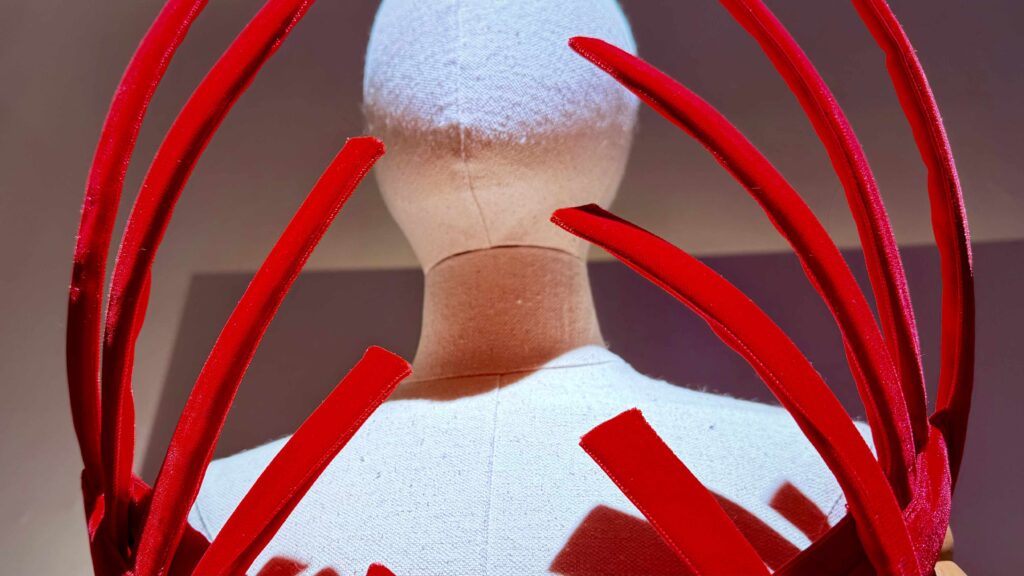
It’s a tall, sculptural design around the neckline and shoulders, made of stiffened strands of haberdashery. Here, the ribbon ceases to be a docile decoration; it becomes an aggressive, vertical vector that gives a woman the look of a futuristic warrior.

Complementing this vision is the bottom of the gown, where the rigor of the weave gives way to a cascade of loose red bands that create a striking, dynamic aura around the legs when in motion.
Ribbon and lace – a detail that does not pass away
Ribbon and lace in the history of high tailoring are much more than ornaments. They are precise instruments with which masters such as Dior, Chanel and Givenchy have been writing a new definition of femininity for decades. In a world dominated by mass production, these fine strands of fabric remind us of the supreme value of time, the precision of the craftsman’s hands and a passion that recognizes no compromise.
This attention to detail already begins in a place invisible to the eye… in the silk weave of the label. The labels of great fashion houses such as YSL, Hermès and Lanvin are themselves works of haberdashery. It is these humble, luxurious strips of fabric that are a kind of seal of quality and identity, tying the history of craftsmanship to the designer’s name.

However, a ribbon can also step out of the shadows and become the main character of a fashion show. It can transform into a monumental, sculptural bow that dominates the silhouette, giving it drama, or into a cascade of fiery ruffles that turn from a haberdashery accessory into an autonomous architecture of desire.

Haute couture is, after all, a constant dialogue that takes place between the artist and the material, between history and the future, and above all between the dress and the GentleWoman who wears it. In this dialogue, the ribbon always has the last word: once in a whisper, hidden under the collar as a status symbol, other times with a shout, as the structural foundation of a creation worth a fortune. It is she who forever binds timeless elegance to intimate comfort.


